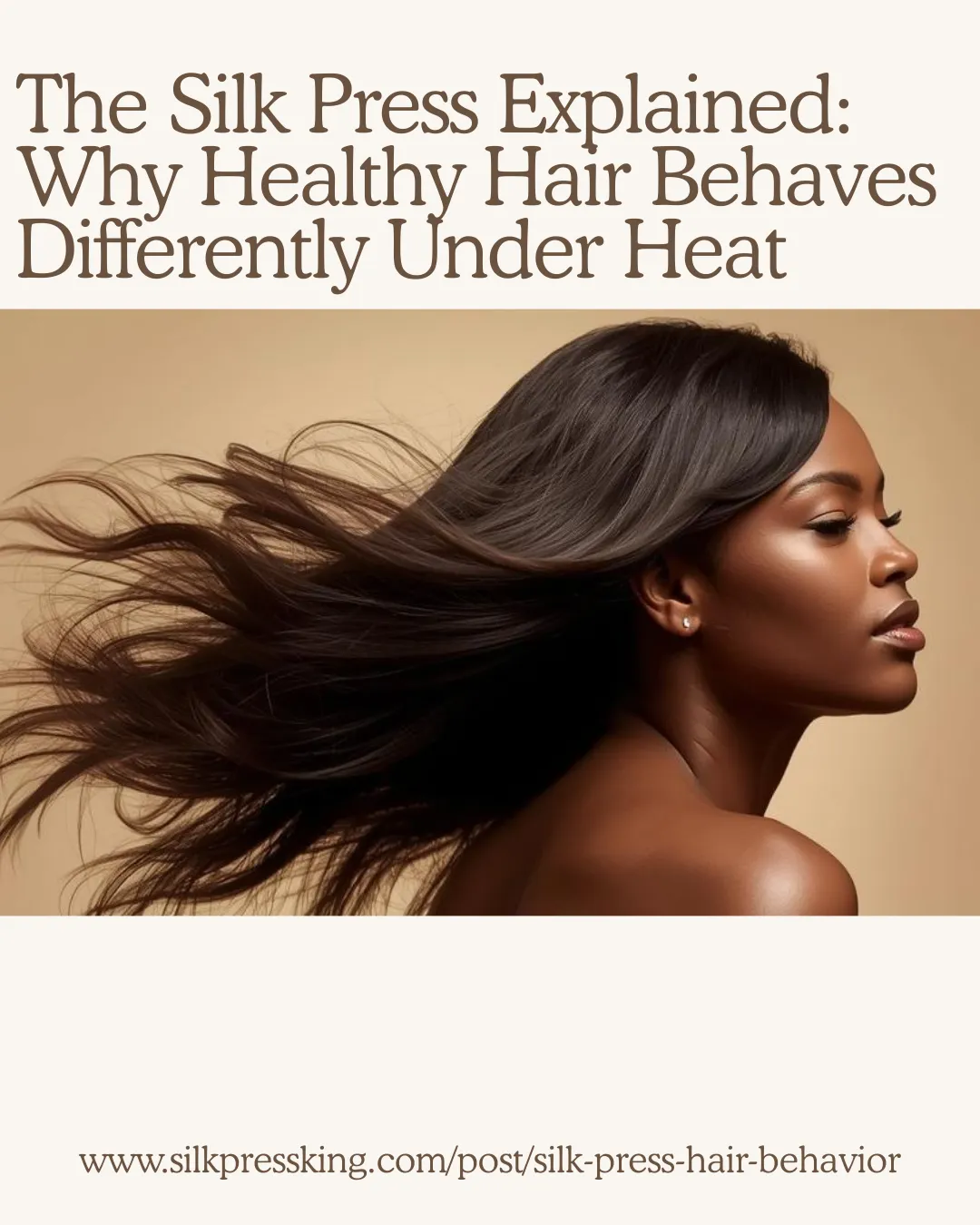
The Silk Press Explained: Why Healthy Hair Behaves Differently Under Heat
For years, the silk press has been misunderstood.
Some see it as a risky heat service. Others see it as a temporary style that inevitably leads to damage, breakage, or reversion. Much of that fear comes from experience—not with the silk press itself, but with how heat has traditionally been applied to textured hair.
The truth is this:
Heat does not automatically damage hair. Poor preparation does.
A silk press is not just a style. It is a response. How hair behaves under heat is determined long before a flat iron ever touches it. When hair is balanced, prepared, and finished correctly, it responds predictably—even under heat.
This is where understanding hair behavior changes everything.
The Common Misconception About Silk Presses
Most people believe that a silk press is simply about straightening hair until it looks smooth and shiny. When reversion happens, the blame usually goes to humidity, weather, or hair “not being meant” to be straightened.
But that explanation skips over what actually matters.
Hair does not react randomly.
It reacts based on structure, balance, and exposure.
When a silk press fails, it is rarely because the hair cannot tolerate heat. It is usually because the hair was:
Over-moisturized or under-supported
Improperly cleansed
Styled with uncontrolled or excessive heat
Finished without sealing or stabilization
These issues are not about the silk press itself—they are about hair behavior.
Understanding Hair Behavior Under Heat
Hair is a fiber. Like any fiber, it responds to:
Moisture levels
Protein strength
Porosity
Temperature
Mechanical stress
When heat is applied to hair, it temporarily changes the way water bonds inside the strand. If that process is controlled and intentional, the hair smooths, elongates, and reflects light. If it is rushed or excessive, the hair becomes stressed and unstable.
Healthy hair behaves differently under heat because:
It absorbs moisture at a controlled rate
It releases moisture without swelling excessively
Its internal bonds are supported, not weakened
Its cuticle lays flatter and seals more easily
This is why two people can receive a silk press on the same day, in the same weather, and have completely different results.
Why Traditional Heat Methods Often Fail Textured Hair
Historically, many ethnic salons relied on tools like pressing combs and direct flame heat. These methods:
Provide inconsistent temperatures
Offer no measurable heat control
Often rely on repeated passes to achieve smoothness
When heat is uncontrolled, stylists are forced to “fight” the hair instead of working with it. This leads to:
Excessive heat exposure
Mechanical stress
Cuticle damage
Loss of elasticity over time
The result is hair that may look smooth initially but becomes weaker, drier, and more prone to breakage with repeated services.
Technology has changed what is possible.
The Role of Measurable, Ceramic Heat
Modern ceramic heat tools allow for precision. Instead of guessing, heat can be applied:
At consistent temperatures
With fewer passes
With less mechanical stress
This shift matters.
Controlled heat allows the hair to respond gradually rather than being shocked. It supports smoothness without forcing the strand beyond its tolerance level. Over time, this approach allows hair to remain:
Stronger
More manageable
Less prone to split ends
More resilient between services
A silk press performed with controlled, measurable heat is fundamentally different from traditional methods that rely on intensity instead of intention.
Preparation Is the Foundation of Every Successful Silk Press
No silk press should begin with a flat iron.
It begins at the shampoo bowl.
Preparation determines performance. This includes:
Proper cleansing to remove buildup that blocks moisture balance
Conditioning that supports both moisture and protein
Treatments that rebalance porosity when needed
Drying techniques that minimize friction and stress
Hair that is improperly prepared will fight the style. Hair that is properly prepared will cooperate.
This is why some silk presses last days and others last weeks—not because of tricks, but because of foundation.
Moisture, Protein, and Balance
One of the most common mistakes in silk press care is assuming that more moisture is always better. While moisture is essential, excess moisture without structure leads to instability.
Hair that is too soft:
Swells quickly
Reverts faster
Loses shape easily
Struggles to hold a finish
Protein provides structure, but too much protein without moisture can make hair brittle.
The goal is not extremes—it is balance.
When moisture and protein are in harmony, hair behaves predictably. It smooths more easily, holds its finish longer, and maintains elasticity even with heat exposure.
Finishing Is Not an Afterthought
The finishing phase of a silk press is where longevity is either secured or lost.
Finishing includes:
Proper sealing
Temperature discipline
Controlled passes
Allowing hair to cool and set
Skipping or rushing this phase leaves hair vulnerable to environmental moisture. Finishing correctly helps stabilize the hair’s new shape and reduce unnecessary reversion.
This step is often overlooked, yet it is one of the most critical.
Why Silk Presses Get a Bad Reputation
Silk presses are often blamed for damage that was already present.
Hair that is:
Over-processed
Chronically dehydrated
Chemically compromised
Structurally weak
will eventually reveal those issues—whether through heat, manipulation, or time.
A silk press does not create damage out of nowhere. It exposes what the hair can and cannot tolerate.
This is why education matters.
The Willie David Hair Approach to Silk Press Services
At Willie David Hair, silk presses are approached as a system, not a one-off service.
The focus is not on forcing straightness, but on supporting healthy hair behavior through:
Balance
Preparation
Controlled heat
Disciplined finishing
Every decision is guided by one question:
How will the hair respond—not just today, but over time?
This approach allows clients to enjoy refined, silky results without sacrificing integrity.
Longevity Is Earned, Not Promised
There is no such thing as a guaranteed silk press.
There is, however, a predictable one.
When hair is balanced, prepared, and respected, it behaves differently. It resists humidity better. It maintains movement. It returns to its natural state without trauma.
This is not luck.
It is understanding.
Reframing the Silk Press Conversation
Instead of asking:
“How long will it last?”
“Will it revert?”
“Is heat bad for my hair?”
A better question is:
How prepared is my hair to respond well to heat?
That shift in thinking changes outcomes.
Understanding your hair is the first step toward healthier results—whether you wear it curly, straight, or somewhere in between.
If you’re interested in learning more about professional silk press services, balanced hair regimens, or products designed to support predictable hair behavior, you can explore additional resources at
www.SilkPressKing.com.
Not as a promise of perfection—but as an extension of education, preparation, and care.
Final Thought
Healthy hair does not need to be forced.
When it is treated correctly, it behaves differently.
That is the truth behind a successful silk press—and the foundation of everything we do.


